
 BM News Feed
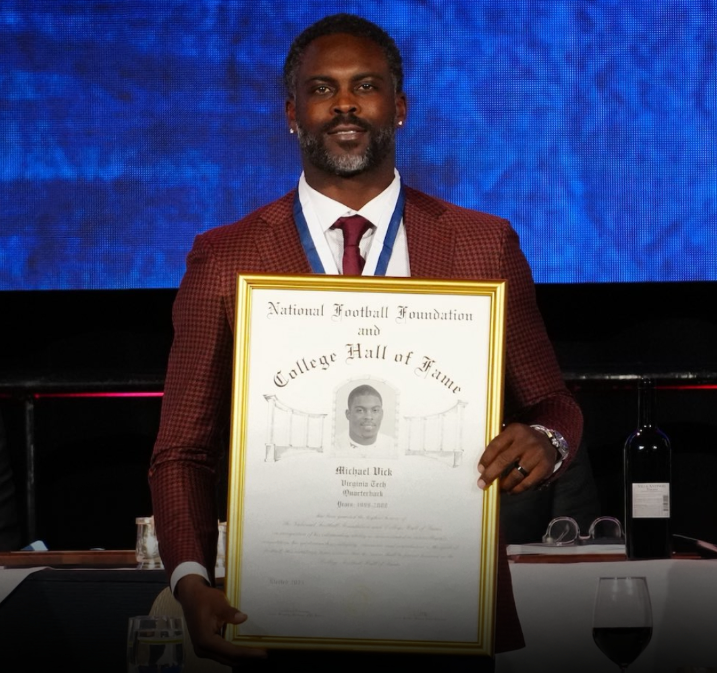
Michael Vick is officially a College Football Hall of Famer, a long-overdue honor that recognizes a legacy far greater than numbers on a scoreboard. His induction is a reflection of how profoundly he changed the game, particularly at the collegiate level, where his talent, creativity, and fearlessness reshaped expectations for what a quarterback could be. This moment marks both celebration and reflection on a career that left a permanent mark on football.
At Virginia Tech, Michael Vick didn’t just play the quarterback position—he redefined it. His speed, arm strength, and improvisational ability created a style of play that felt revolutionary at the time. Defenses struggled to contain him, not because of complex schemes, but because his athleticism broke traditional football logic. Watching Vick was an experience; every snap carried the possibility of something unforgettable.
Vick’s impact went beyond highlight plays. He helped elevate Virginia Tech into national prominence, leading the Hokies to a national championship appearance and making the program a consistent threat on the biggest stage. His presence changed how teams prepared, forcing coaches and players to rethink defensive strategies and player development. He proved that leadership at quarterback could come in many forms, including speed, instinct, and raw creativity.
What made Vick truly special was how natural the game looked when he played. He blended calm confidence with explosive ability, making difficult plays appear effortless. His performances inspired a generation of young athletes who finally saw someone who looked like them thriving in a role that had long been defined by a narrow mold. His success opened doors and expanded imagination across the sport.
After college, Vick went on to become one of the most electrifying players the NFL has ever seen. While his professional career had highs and lows, the influence of his style carried forward. The modern NFL quarterback—mobile, versatile, and dynamic—owes much to the blueprint Vick introduced. Players who followed benefited from the path he helped carve, even if they never played quite like him.
The Hall of Fame recognition focuses on his college career, and rightly so. It honors what he accomplished on the field during those formative years and the cultural shift he helped create. College football is about more than championships; it’s about moments that change the sport’s direction. Vick delivered many of those moments, leaving fans and opponents alike in awe.
This induction also represents growth and perspective. Time allows legacies to be viewed with greater clarity, acknowledging both brilliance and complexity. Honoring Vick’s collegiate impact does not ignore the full scope of his life and career—it recognizes that influence, innovation, and excellence can coexist with lessons learned along the way.
For Virginia Tech fans, this moment is deeply personal. Vick remains a symbol of pride and a reminder of one of the most exciting eras in the program’s history. For football fans more broadly, it’s a chance to reflect on how one player altered the sport’s evolution in ways that are still visible today.
Ultimately, Michael Vick’s induction into the College Football Hall of Fame is about transformation. He didn’t just succeed within the game as it was—he changed what the game could be. His impact has always been bigger than statistics, bigger than records, and bigger than any single season. It lives on in the way football is played, watched, and imagined, making his place in history undeniable and well deserved.